Today is the day
23/07/26 09:06
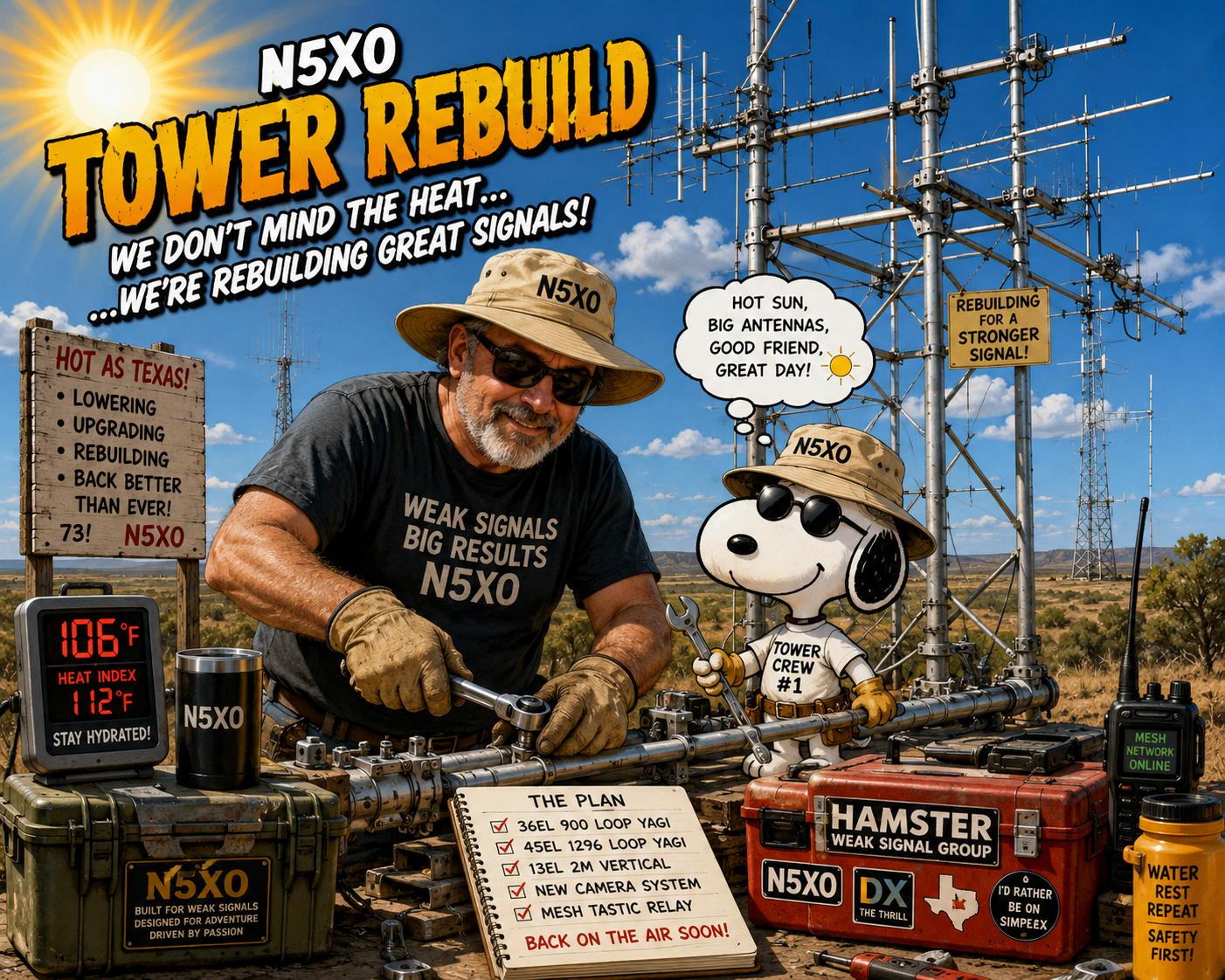
After months of planning, ordering equipment, repairing storm damage, and waiting for the right opportunity, the next major phase of the N5XO Weak Signal Station officially begins.
This morning we'll be lowering one of the largest H-frame antenna assemblies on the property to begin a complete rebuild and upgrade. It's a project that has been in the planning stages since lightning struck the station, and by the time we're finished, this tower will be significantly more capable than it has ever been.
What We're Lowering
The H-frame currently supports an impressive collection of antennas and equipment, including:
- Two stacked 2-meter Quad antennas
- One 1.25-meter Quad
- Two stacked 36-element 1296 MHz Yagis
- A solar-powered Meshtastic relay
- A G7 2-meter FM simplex antenna
- Two stacked K5VH omnidirectional antennas used for weak-signal SSB work
Recovering From the Lightning Strike
Mother Nature had other ideas earlier this year.
A lightning strike took out several important pieces of equipment, including:
- The 180-degree 8-megapixel panoramic camera
- The solar-powered Meshtastic relay
- Damage to other station equipment that has already been repaired or replaced
The Upgrades
When this project is complete, the tower will return to service with a number of exciting additions.
900 MHz Weak Signal Expansion
One of the most exciting additions is a 36-element 900 MHz Loop Yagi, giving us greatly improved performance on one of my favorite weak-signal bands.
Bigger Performance on 1296 MHz
The pair of stacked 36-element 1296 MHz Yagis will be replaced with a single high-performance 45-element Loop Yagi.
Sometimes bigger isn't simply more antennas—it's better engineering. This new antenna promises outstanding gain while simplifying the overall installation.
New Camera System
The destroyed panoramic camera will be replaced with a much more capable surveillance system.
The new installation will include:
- Dual-head camera system
- Infrared night vision
- 4-megapixel imaging
- Continuous monitoring of the other towers
- Weather observation
- Horizon monitoring
- Additional station security
Meshtastic Returns
The Meshtastic solar relay is also being completely rebuilt and returned to service.
The relay has become an important part of our growing regional mesh network, and I'm looking forward to getting it back on the air.
More FM Simplex Range
One addition I've wanted for quite some time is a dedicated 13-element vertically polarized 2-meter beam.
The goal is simple:
Push our FM simplex coverage even farther across South and Central Texas.
As many of you know, I've become a huge believer that FM simplex is one of the most underused capabilities in amateur radio. Every improvement we make helps demonstrate just how far simplex communication can really go when stations are properly equipped.
Working Around the Texas Heat Dome
The biggest challenge may not be the antennas...
It may be the weather.
Central Texas is currently sitting beneath an intense heat dome, meaning we'll be working around dangerous afternoon temperatures. Safety comes first, so most of the heavy work will happen during the cooler morning hours, with shorter work sessions once the Texas sun begins doing what it does best.
If Mother Nature cooperates, I'm hoping to have everything rebuilt, tested, and back in the air within one to one-and-a-half weeks.
Building the Ultimate Weak Signal Station
Every improvement brings us one step closer to the vision I've had for years—a station capable of operating continuously from 160 meters all the way through 10 GHz, supporting everything from local FM simplex to long-distance weak-signal work, microwave experimentation, emergency communications, Meshtastic networking, and beyond.
This isn't just maintenance.
It's another major step toward building one of the most versatile VHF/UHF/SHF amateur radio stations I've ever imagined.
Stay Tuned
Over the coming days I'll be posting photos, videos, drone footage, progress reports, and hopefully plenty of stories from the rebuild.
By the time this project is complete, the tower will not simply be repaired—it will be stronger, smarter, and more capable than ever before.
The tower is coming down...
So it can come back up better than ever.
73,
Greg Lewis – N5XO Founder, HAMster Weak Signal Group
The Final Phase Begins – Building the Ultimate N5XO Station
13/07/26 09:53
There are moments in every Amateur Radio operator's journey that mark the end of one chapter and the beginning of another.
For me, that chapter begins this Wednesday.
After months of planning, repairing, redesigning, ordering parts, running new feedlines, and recovering from the lightning strike that did so much damage to our station, it is finally time to begin the final phase of the N5XO shack and antenna farm rebuild.
This isn't simply replacing broken equipment.
This is taking everything we've learned over the years—and building something even better.
Every Project Has a Goal
When I first became interested in Amateur Radio decades ago, my goal wasn't simply to talk on the radio.
It was to experiment.
To see just how far I could push my station.
To learn.
To build.
To improve.
That spirit has never changed.
The station has evolved from a simple VHF setup into a complete communications system capable of operating across virtually every Amateur Radio band. Every antenna, every feedline, every amplifier, every relay, and every piece of equipment has a purpose.
Now it's time to put the finishing touches on what has become one of the most exciting station projects I've ever undertaken.
The Work Begins
The first task will be assembling several brand-new antennas before they ever leave the ground.
Among them are two new Big Wheel 144 MHz omnidirectional antennas that will replace the faithful K5VH omnis that unfortunately became the latest victims of our local "tower maintenance crew"...
...otherwise known as the buzzards.
Those birds have managed to destroy more antennas over the years than some Texas windstorms.
The new Big Wheels should provide excellent omnidirectional horizontal coverage for weak-signal work while being considerably more rugged.
Next on the workbench is a 900 MHz antenna, adding another important piece to the station's expanding microwave capabilities.
Then comes one of the projects I'm most excited about...
A beautiful new 45-element Loop Yagi for 1296 MHz.
This antenna will replace my stacked pair of 36-element Loop Yagis and should provide even better performance on the 23-centimeter band. Every decibel counts when you're chasing distant stations, weak-signal contacts, contests, and eventually expanding even further into microwave operations.
The improvements never stop.
Giving Old Equipment New Life
Not every project involves something brand new.
One of my trusted 13-element vertical Yagis will be repaired and returned to service.
That antenna has proven itself over the years, and once back in the air it will once again serve as my long-range FM simplex antenna.
One thing our HAMster Simplex Nets have demonstrated is that repeaters aren't the only way to communicate over impressive distances.
A well-designed station...
A quality antenna...
Good feedline...
And a willingness to experiment...
Those things still matter.
Expanding the Mesh Network
Another exciting addition will be reinstalling the Meshtastic Relay that was lost in the lightning strike.
The replacement relay will once again occupy its home high on the main tower alongside the omnidirectional antennas, restoring local mesh coverage.
But we're not stopping there.
A second Meshtastic relay will be installed on another tower and paired with a highly directional dish antenna capable of being rotated as needed.
That opens the door to experimenting with long-distance mesh links and extending network coverage well beyond what an omnidirectional antenna alone could accomplish.
Experimentation is, after all, what Amateur Radio has always been about.
Infrastructure Matters
One thing most people never notice when looking at an antenna farm is what lies behind the scenes.
Feedlines.
Connectors.
Grounding.
Routing.
Planning.
Fortunately, one of the largest jobs has already been completed.
Every new feedline has already been run into the shack and terminated.
That means when antennas start going up, the infrastructure is already waiting for them.
Sometimes the work nobody sees is the work that makes the biggest difference.
Time to Lower the Towers
Toward the end of the week—or perhaps over the weekend if Mother Nature cooperates—the real fun begins.
The towers will come down.
Old antennas will come off.
New antennas will go up.
Systems will be tested.
Everything will be tuned.
Every connector checked.
Every feedline verified.
There is something incredibly satisfying about seeing months of planning finally become reality.
We're Bringing You Along
This isn't going to be one of those projects that disappears into the background.
I'm planning to document as much of it as possible.
There will be aerial footage from the drone.
GoPro footage from a head-mounted camera while working on the antennas.
Ground cameras capturing the assembly.
Time-lapse video where possible.
Hopefully you'll get to see the entire project unfold—from antenna assembly on the ground to the final installation high above the shack.
If you've ever wondered what goes into building a serious VHF/UHF/Microwave station, I think you'll enjoy following along.
One More Upgrade...
As if all that wasn't enough...
The HF station is getting some attention as well.
The existing dipole will be replaced with a new antenna, continuing the overall modernization of the station.
HF has always been an important part of the shack, and this upgrade helps ensure every part of the station is performing at its very best.
The Goal
When all of the work is complete...
Every antenna is mounted.
Every feedline connected.
Every radio tested.
Every system verified.
The N5XO station will have continuous operating capability with no gaps from 160 meters all the way through 10 Gigahertz.
Think about that for a moment.
Every Amateur Radio band from 160 meters through the microwave bands.
HF.
6 Meters.
2 Meters.
1.25 Meters.
70 Centimeters.
33 Centimeters.
23 Centimeters.
13 Centimeters.
3 Centimeters.
10 Gigahertz.
No missing bands.
No compromises.
Just a station designed to experiment, explore, communicate, and continue pushing the limits of what Amateur Radio can do.
The Adventure Continues
People sometimes ask why I continue adding antennas, experimenting with new bands, building new systems, or chasing contacts that many would consider impossible.
The answer is simple.
Because Amateur Radio was never intended to be a hobby where we stop learning.
It's a hobby where we continually ask, "What happens if I try this?"
It's about building.
Experimenting.
Improving.
Sharing what we learn.
Encouraging others to build bigger dreams than they thought possible.
So over the next several days, the work begins.
The cameras will be rolling.
The towers will be moving.
The antennas will be flying.
And I hope you'll come along for the ride.
73,
Greg Lewis – N5XO
"Never stop experimenting. The next great contact is always just one improvement away."